GUIDES
Marketing Strategy vs. Channels: What Should Stay Fixed and What Should Flex
DIRECT ANSWER
Your marketing strategy — positioning, north-star KPI, and two or three growth pillars — should stay fixed and be reviewed only quarterly. Your channel priorities should flex monthly based on performance data. Keep the two review loops separate: underperforming channels are an execution problem, not a strategy problem. You can only flex channels wisely if you understand the whole funnel, because channels hand off to each other at every stage.
Two Ways a Marketing Team Falls Apart
There are two ways a marketing team falls apart. The first is familiar: no real strategy. The team chases whatever worked last quarter, reacts to every competitor move, pivots to a new channel every six months because the previous one "isn’t working." The work never compounds. The brand never gets any sharper. Three years in, you’ve done a lot of things and built nothing.
The second failure is less talked about, but just as common: strategy so rigid it becomes a cage. The annual plan is set in Q4, every channel gets its budget, and then the team executes — no matter what the data says, no matter what shifts in the market. When a channel stops performing, the response is "push harder." When a new platform emerges that your audience is actually on, you’re not allowed to touch it until next year’s planning cycle.
Both failures come from the same misunderstanding: treating strategy and channel execution as the same thing, when they need to operate on completely different timescales.
The Stable Core: What Should Never Change (Much)
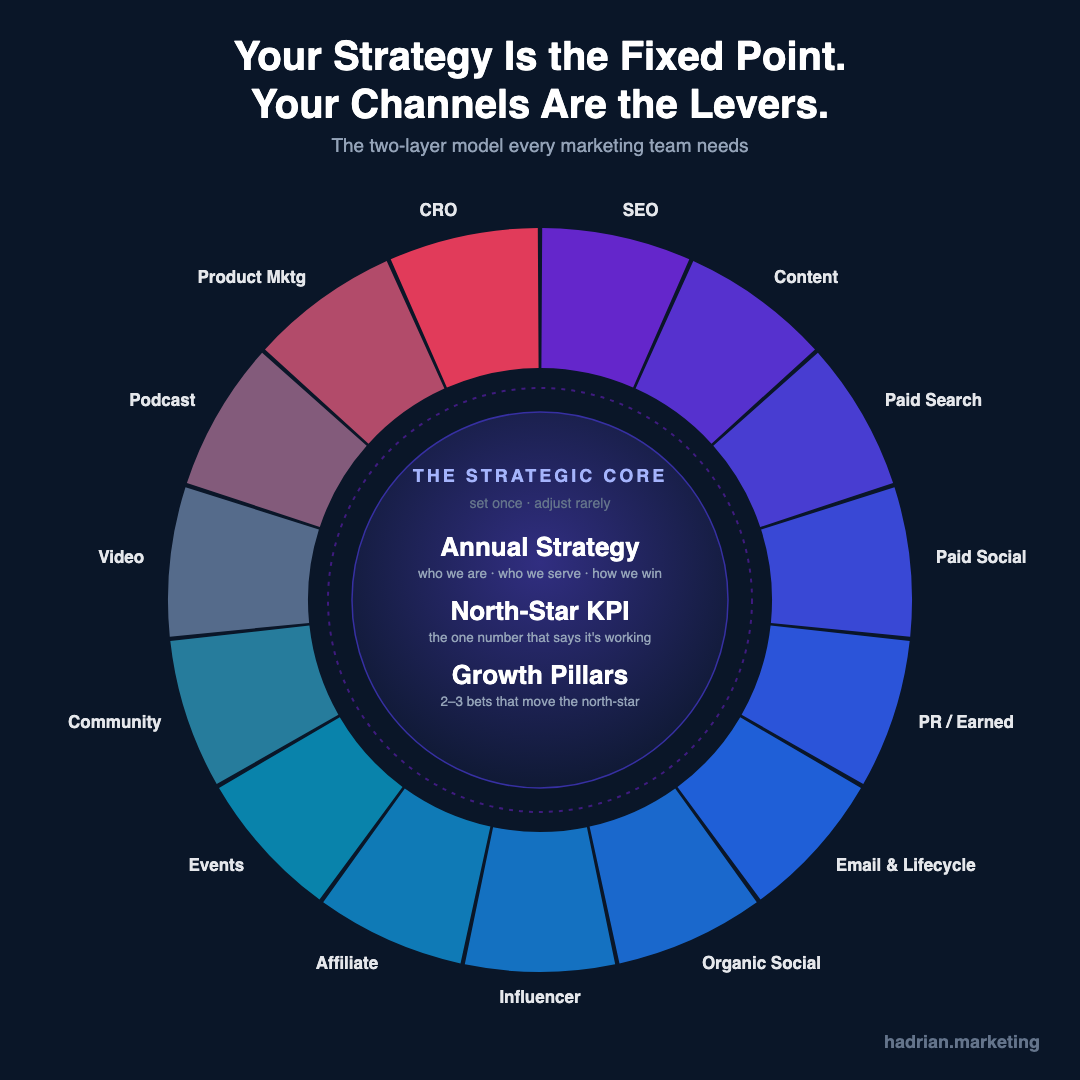
Think of your marketing function as having two distinct layers. The first is the foundation — the part that should feel almost boring in its consistency.
Your annual strategy answers the existential questions: What are we selling, to whom, and why should they care? What’s the brand position we’re trying to own in the market? What category are we competing in and how are we different from the alternatives? These answers shouldn’t change every quarter. They shouldn’t change every year, frankly, unless the business itself is pivoting. Companies that cycle through "brand refreshes" every 18 months aren’t being agile — they’re avoiding the hard work of actually holding a position long enough for it to mean something.
Your north-star KPI is the single number that tells you whether you’re winning. Not a dashboard of twelve metrics. One number — the one that, if it moves in the right direction, means the whole machine is working. For an acquisition-led business it might be qualified leads. For a product-led business it might be active accounts. For a publisher it might be engaged monthly readers. The choice matters less than the discipline of choosing — and then not changing it constantly. When teams swap north-star metrics every few months, they destroy their ability to measure compound progress.
Your growth pillars are the two or three bets that support the north-star. These are the strategic choices about how you’ll grow — maybe it’s organic search authority and brand-building content, plus an affiliate and partnerships channel, plus a lifecycle engine that converts free users to paid. Maybe it’s a community flywheel, a product-led loop, and PR-driven earned credibility. The pillars define where you concentrate across an otherwise enormous menu of possible marketing investments. They’re more durable than any individual campaign or channel.
Together, these three — strategy, north-star KPI, growth pillars — form the stable core. They should be reviewed maybe once a year, adjusted only when the business fundamentally changes, and otherwise kept fixed. They are the thing you come back to when you’re not sure what to do. The answer to "should we do this?" is: does it feed a growth pillar? Does it move the north-star? Does it reinforce our strategy? If yes, do it. If not, don’t.
The Flexible Layer: What Should Change Constantly
The second layer is channel execution — and here, the rules flip completely.
Channels are just delivery mechanisms. They’re the roads you use to reach your audience. And the full map of possible roads is enormous: SEO and content, paid search, paid social, PR and earned media, email and lifecycle/CRM, organic social, influencer and creator programs, affiliate and partnerships, events and field marketing, community building, video, podcast, product marketing, CRO and experimentation. Most teams can’t run all of them well simultaneously — nor should they try.
The road that works best changes over time. Algorithms shift, platforms age, new surfaces emerge, audience behavior drifts, seasonality moves the relative efficiency of each channel up or down. A content program that drives strong organic traffic in one period might be outperformed by a partnerships push in another. A paid social channel that converts well early on might hit audience saturation by mid-year. Events that were core pre-2020 may now deliver a fraction of the pipeline they used to. Affiliate programs that seemed marginal may have quietly become one of your best-performing channels.
If your strategy locks your channels, you lose the ability to respond to any of that. And because channels interact — a PR hit amplifies your SEO rankings, a strong community creates organic social reach you can’t buy, a lifecycle email sequence can convert the leads your paid campaigns brought in — being rigid about any one channel creates drag on all the others.
This is where a lot of teams get it wrong. They confuse "having a channel strategy" (good) with "never changing what channels get prioritized" (bad). Every channel your team runs should have its own operating logic, its own KPIs, its own role in the funnel — but those priorities should be reviewed on a tight cadence and adjusted when the data says to.
How to Run It: The Two-Cadence Model
The practical version of this framework is two review loops running at different speeds.
Slow loop (quarterly or semi-annual): strategy and pillars. Every quarter, revisit the core: is the north-star still the right north-star? Are the growth pillars still the right bets? Has anything in the competitive landscape changed the strategic position? These reviews should mostly produce minor adjustments, not overhauls. A good sign is when the quarterly strategy review is calm — the hard thinking happened at the start of the year, and now you’re just pressure-testing it against what you’ve learned.
Fast loop (monthly): channel priorities. Every month, look at how each channel is performing against its role in your growth pillars. Which channels are over-indexing on results? Which are hitting diminishing returns? Is there a new channel or tactic worth a limited test? This is where you redistribute attention and budget — not based on gut feel, but on what the north-star KPI data is telling you.
The discipline is keeping these two loops separate. When a channel starts underperforming, the instinct is to question the strategy. That’s almost always wrong. Underperforming channels are an execution and prioritization problem, not a positioning problem. Don’t blow up the strategy because LinkedIn isn’t converting this quarter. Adjust the channel. Hold the strategy.
The signal that it is a strategy problem: multiple channels are underperforming simultaneously, your north-star has been flat or declining across several review cycles, and no change in channel execution seems to move it. That’s when you revisit the core.
Why You Can Only Flex Channels Wisely If You Understand the Whole Funnel
Here’s the piece that most channel-specific advice misses: your channels don’t operate in isolation. They hand off to each other at every stage of the funnel.
A blog post that ranks well in organic search generates awareness. It hands off to a lead magnet or newsletter signup, which hands off to a lifecycle email sequence, which hands off to a sales conversation or a free trial activation. An influencer mention sends traffic to a landing page optimized by CRO experiments. A PR placement earns a backlink that strengthens the SEO authority of a pillar page. An event conversation that starts on-site continues through community and email. Each transition is a hand-off, and the funnel is a chain of them.
If you change one channel’s behavior — say, you reduce content volume and focus on fewer, deeper pieces — that decision ripples forward through everything downstream that depends on that top-of-funnel traffic. If you pull back on paid social without a plan for organic social and community to absorb some of that awareness load, your middle-funnel will thin out a few months later and you won’t immediately know why.
This is why channel decisions can’t be made in silos. The person running paid search needs to understand what lifecycle is doing with the leads they’re sending. The person running content needs to understand what kind of audience the sales or partnerships team actually wants. The person optimizing the channel mix needs to see how the whole funnel connects before deciding which levers to pull.
A marketing team that lacks this cross-funnel literacy will make locally correct decisions that are globally wrong. They’ll optimize a channel metric — more clicks, a higher open rate, a lower CPL — without understanding whether they’re actually moving the north-star. They’ll shift budget toward a channel that looks efficient in isolation, without understanding that it’s pulling traffic that used to convert better through a different path.
This is what holistic thinking actually means in practice: you’re not expected to be an expert in every channel. But you need to know enough about each one to understand what it contributes to the funnel, what it receives from the channels above it, and what it hands off to the channels below. When you’re deciding whether to flex a channel priority, that cross-funnel view is what makes the decision intelligent rather than reactive.
The Decision Framework: When to Shift a Channel vs. Hold the Line
In practice, the question that comes up most often is: "This channel isn’t working — should we pull back?" Here’s a simple frame for making that call.
Hold the line when: the channel is strategically important to a growth pillar, but is in an early or seasonal trough; the underperformance is in a channel metric, not in downstream north-star impact; you haven’t given the channel enough time or enough quality execution to fairly evaluate it; or the rest of the funnel depends on this channel’s output in a way that a pivot would break.
Shift when: north-star impact from this channel has been flat or declining across two or more review cycles; a different channel is showing better efficiency on the same growth pillar; the audience has measurably shifted away from this channel (you can see this in engagement patterns and traffic trends); or you’ve tested enough variations to be confident it’s a channel fit problem, not an execution problem.
The key is that both decisions should trace back to your north-star and growth pillars. "This channel feels stale" is not a reason to shift. "This channel is no longer moving the metric that matters, and here’s the data" is.
The Meta-Lesson
The teams that compound over time aren’t the ones that find the cleverest tactics or are first to every new platform. They’re the ones that are boring about their strategy and disciplined about their reviews — clear enough on where they’re going that channel pivots are calm adjustments rather than existential crises.
The strategic root is stable. The channels are levers. Keep them sorted.
This is the design principle behind how Hadrian structures the client brain: the annual strategy and north-star KPI become the stable root that every agent and every channel execution reads from — and the channel strategies built on top of it are reviewed and updated on a faster cadence. The fixed root makes the flexible execution possible. Hadrian helps marketing teams build and run that loop — the strategy at the root, the channels flexing on top, the whole funnel connected.
FAQ
Marketing Strategy vs. Channels — common questions
How often should your marketing strategy change?
Your core marketing strategy — positioning, north-star KPI, and growth pillars — should change rarely: review it quarterly, but expect most reviews to produce minor adjustments, not overhauls. It should only change substantially when the business itself is pivoting. Channel priorities, by contrast, should be reviewed and adjusted monthly based on performance data.
What is the difference between marketing strategy and channel strategy?
Marketing strategy is the stable core: what you sell, to whom, the position you want to own, your single north-star KPI, and the two or three growth pillars you concentrate on. Channel strategy is the flexible execution layer — which delivery mechanisms (SEO, paid, email, PR, community, etc.) you prioritize to serve those pillars. Strategy is reviewed quarterly and held steady; channels are reviewed monthly and changed as the data dictates.
When should you drop or shift a marketing channel?
Shift a channel when its north-star impact has been flat or declining across two or more review cycles, when a different channel shows better efficiency on the same growth pillar, when the audience has measurably moved away from it, or when you’ve tested enough to be confident it’s a channel-fit problem rather than an execution problem. Hold the line when the channel is in an early or seasonal trough, the weakness is only in a surface metric rather than downstream results, or the rest of the funnel depends on its output.
Why do you need to understand the whole funnel before changing channels?
Channels hand off to each other at every stage — organic content feeds email, PR strengthens SEO, paid feeds lifecycle. Changing one channel ripples forward into everything downstream that depends on it. Without a cross-funnel view you’ll make locally correct decisions that are globally wrong: optimizing a channel metric like CPL or open rate while unknowingly starving a path that converted better. Whole-funnel literacy is what makes a channel decision intelligent rather than reactive.
FOUNDING COHORT · FIRST 25 TEAMS
Become a founding member of Hadrian — the autonomous CMO.
Lock founding pricing for life, and we'll build your brand brain and your first 30-day marketing plan for you — free. This very page was written by the same agents you'd run.