GUIDES
Top AI Tools for a Full Marketing Team (2026)
DIRECT ANSWER
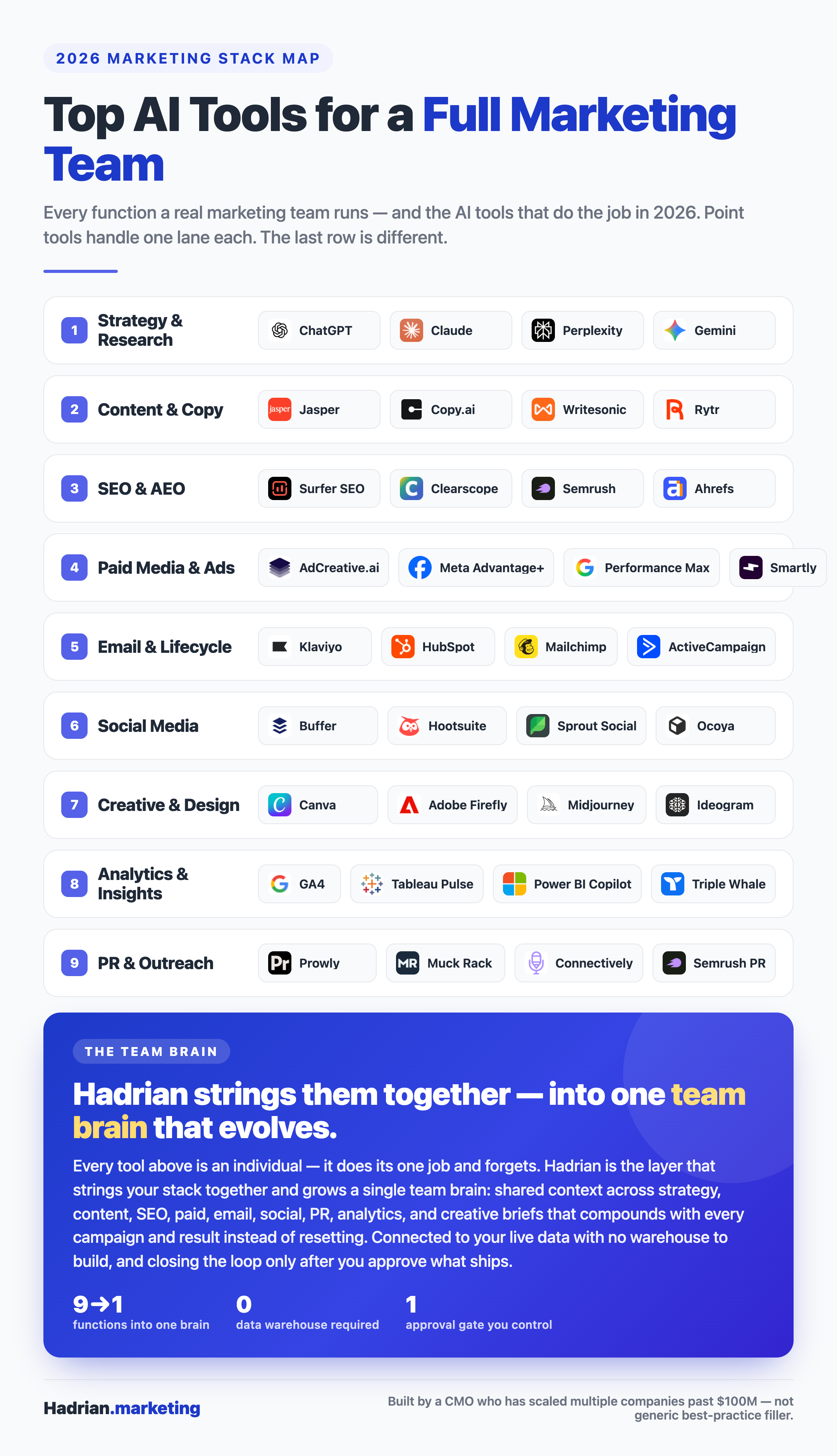
A full marketing team covers nine functions, and in 2026 each has strong AI tools: strategy (ChatGPT, Claude, Perplexity), content (Jasper, Copy.ai), SEO/AEO (Surfer, Clearscope, Semrush), paid media (AdCreative.ai, Meta Advantage+), email/lifecycle (Klaviyo, HubSpot), social (Buffer, Sprout Social), creative (Canva, Adobe Firefly, Midjourney), analytics (GA4, Tableau Pulse, Power BI Copilot), and PR (Prowly, Muck Rack). Each tool does one job well. The gap most teams hit is orchestration: the tools stay individual and forget each other, so nobody strings them into one team with shared, evolving context. That connective 'team brain' is a different category of tool.
Start With Functions, Not Tools
The fastest way to waste a marketing budget in 2026 is to buy AI tools before you have mapped the functions they are supposed to serve. A real marketing team — of any size — has to cover nine jobs: strategy and research, content and copy, SEO and answer-engine optimization, paid media, email and lifecycle, social, creative and design, analytics, and PR. Every tool on the market slots into one of these lanes. If you shop by lane instead of by hype, the choices get obvious fast.
This matters more now than it did two years ago, because the tools have gotten good enough that the bottleneck is no longer capability — it is coordination. A great content tool that has no idea what your paid team is testing, or an SEO tool that never sees what your PR team just landed, produces work that is locally optimal and globally disconnected. Map the ten functions first, decide which ones you actually run, and only then pick the tool for each.
The Nine Functions and the Tools That Own Them
Strategy and research is where large language models earn their keep — ChatGPT, Claude, Perplexity, and Gemini are the default thinking partners for positioning, briefs, and competitive teardowns. Content and copy is the most crowded lane: Jasper, Copy.ai, Writesonic, and Rytr all generate volume, though the differentiator now is brand-voice consistency, not raw output.
For SEO and AEO, Surfer SEO and Clearscope handle on-page optimization while Semrush and Ahrefs own the research and rank-tracking side — and all four are racing to answer the new question of how to get cited by AI answer engines, not just ranked in blue links. Paid media has moved toward platform-native automation (Meta Advantage+, Google Performance Max) plus creative-generation layers like AdCreative.ai and Smartly.
Email and lifecycle is anchored by Klaviyo, HubSpot, Mailchimp, and ActiveCampaign, each now shipping AI campaign generation. Social runs on Buffer, Hootsuite, Sprout Social, and Ocoya. Creative and design belongs to Canva, Adobe Firefly, Midjourney, and Ideogram. Analytics and insight tooling — GA4, Tableau Pulse, Power BI Copilot, Triple Whale — turns the data into answers, and PR and outreach is served by Prowly, Muck Rack, Connectively, and Semrush's PR toolkit.
Any one of these tools, chosen well for its lane, is a good buy. The honest caveat is that owning nine best-in-class tools does not give you a marketing team. It gives you nine tabs.
Where Point Tools Stop: The Orchestration Gap
Here is the failure mode nobody sells against: each of the tools above is stateless with respect to the others. Your content tool does not know what your SEO tool found this morning. Your paid tool cannot see the email performance that would tell it which message to scale. A human — usually the founder or a lone marketer — becomes the integration layer, copying context between tabs, and that human is the actual bottleneck. The tools got faster; the coordinating human did not.
This is why the most valuable category in the 2026 stack is not a better point tool — it is an orchestration layer that runs across all the functions with shared context and a single place to approve what ships. The test for whether something is orchestration versus just another tool is simple: does it hold persistent memory of your brand, your competitors, and your past campaigns, and does it hand work between functions without a human re-explaining everything each time?
How Hadrian Fits — It Strings Them Together Into a Team Brain
Hadrian is built for exactly the gap the point tools leave open. It does not replace the tools above and it is not one more individual in the stack — it is the layer that strings them together. Instead of nine functions each acting alone and forgetting, Hadrian coordinates the work across strategy, content, SEO, paid, email, social, PR, and analytics — plus creative briefs that hand your designers a ready-to-execute spec — and holds it all in one shared context so each function is aware of the others.
What makes that durable is the second idea: the context does not reset between sessions, it evolves. Every campaign, every brief, every result feeds back into a single team brain that gets sharper over time — the opposite of a tool that starts cold every morning. Two design choices keep it practical: it connects to your live data without asking you to build a data warehouse first, and nothing ships autonomously — every output waits behind an approval gate you control. You set the strategy and review the work; the shared brain compounds.
The tools in this guide are the right starting point for any marketing team building its stack in 2026. The moment you are running more than one channel, the question stops being which tool is best in each lane and becomes who is running them as one team — and that is a category of its own.
FOUNDING COHORT · FIRST 25 TEAMS
Become a founding member of Hadrian — the autonomous CMO.
Lock founding pricing for life, and we'll build your brand brain and your first 30-day marketing plan for you — free. This very page was written by the same agents you'd run.