RESOURCES
State of AI Marketing 2026: The Benchmark Report
DIRECT ANSWER
In 2026, most marketing teams have adopted AI inside individual functions — content drafting, SEO briefs, ad creative, email copy — but almost none have coordinated it across functions. The typical team now runs 5-8 disconnected AI point tools, each re-taught the brand from scratch, with no shared memory or strategy layer between them. That coordination gap, not a lack of AI tools, is the structural problem the category has not solved.
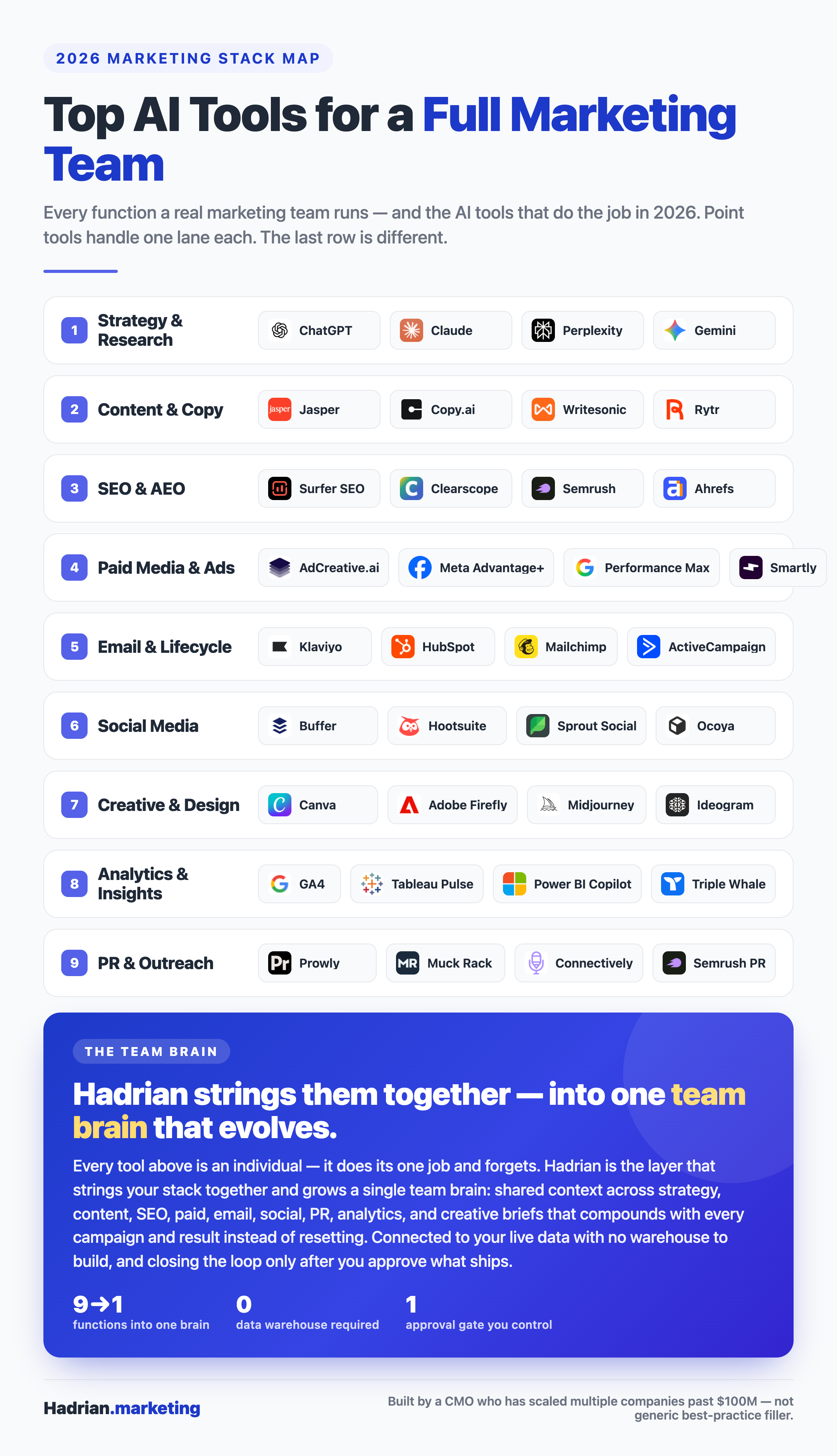
The 6 functions of a modern marketing team — at a glance
| Function | What AI does today | Example tools | Best for |
|---|---|---|---|
| Strategy & planning | Synthesizes a plan from goals + performance data | ChatGPT, Claude, Notion AI | Teams re-planning quarterly by hand |
| Content | Drafts blogs, social, newsletters, landing copy | Jasper, Copy.ai, Claude, Surfer SEO | Highest-volume function, biggest quick win |
| SEO & AI visibility | Structures content for search + answer engines | Surfer SEO, Clearscope, Ahrefs, Semrush | Teams losing organic + AI-citation share |
| Paid media | Runs creative + bid optimization loops | Meta Advantage+, Google PMax, Smartly.io | Teams with active ad spend, thin optimization time |
| Lifecycle & email | Builds flows, tests subject lines + send times | Klaviyo AI, HubSpot Breeze | Teams with an underused welcome/flow sequence |
| Creative | Generates first-draft images/video, variant testing | Midjourney, Canva Magic Studio, Adobe Firefly | Fast hook/thumbnail testing before final production |
| PR & authority | Drafts pitches, releases, founder thought-leadership | Prowly, ChatGPT, Claude | Founder-led brands without a PR hire |
Executive summary
Marketing teams did not skip the AI adoption curve — if anything, they over-adopted. Most teams we talk to already run AI inside content, SEO, paid creative, and email. The problem was never 'we have no AI.' It's that every one of those tools operates in its own tab, with its own memory, re-explaining the brand from scratch every time a human pastes in a prompt.
This report walks the six functions a modern marketing team covers, names the real tools operators use in each one today (including tools that have nothing to do with Hadrian), and gives a calm, non-disruptive sequence for tightening the stack. It closes with the one structural gap that no point tool — including most of the ones named in this report — actually fixes.
The challenge, in numbers
Marketing budgets have not kept pace with the tool sprawl. Gartner's CMO Spend Survey has tracked marketing budget as a share of company revenue trending flat-to-down for several years running, even as the number of martech tools in the average stack has kept climbing — most industry stack surveys (HubSpot's State of Marketing, Chief Marketing Technologist's Martech Landscape) put the typical mid-size team's tool count well into the double digits.
Headcount is the traditional fix, and it's expensive: a single fully-loaded in-house marketing hire commonly runs $90,000-$150,000/year in the US once benefits and overhead are included, and a lean 3-5 person in-house team routinely clears $350,000-$600,000/year fully loaded. Agency retainers are the other lever — typically $8,000-$15,000+/month for a generalist agency, before media spend.
Meanwhile LinkedIn and Forrester have both published research (2025-2026) showing AI-assisted content and campaigns increasingly influence what buyers see and cite — but only when that content is structured and consistent enough for AI answer engines to extract, which is exactly what happens when six disconnected tools produce six different voices for the same brand.
The 6 functions, stage by stage — what AI actually does, and where to start
Strategy & planning. AI can synthesize a weekly or quarterly plan from your goals, past performance, and market signals — but almost no team has wired this to run continuously; most redo it by hand in a doc every quarter and let it go stale within weeks. Tools operators actually use: ChatGPT/Claude for drafting, Notion AI for synthesis. Start here: paste last quarter's plan and this quarter's numbers into one thread and ask for the 3 things that changed.
Content. The highest-volume function and the first one teams automate — blogs, social, newsletters, landing copy. Real tools in daily use: Jasper, Copy.ai, ChatGPT/Claude directly, Surfer SEO for on-page structure. Start here: pick your single best-performing piece from last year and have AI draft 3 variants before writing anything from scratch.
SEO & AI visibility. Getting found by Google and cited by answer engines (ChatGPT, Perplexity, Google AI Overviews) now depends on structure — clear headers, direct answers, cited data, comparison tables — as much as keywords. Real tools: Surfer SEO, Clearscope, Ahrefs/Semrush for research. Start here: run your top landing page through an AEO checklist — does it answer the query in the first 100 words?
Paid media. AI now runs most of the optimization loop inside the ad platforms themselves. Real tools: Meta Advantage+, Google Performance Max, Smartly.io for creative automation at scale. Start here: let the platform's native AI optimization run on your best-performing campaign before building a custom model.
Lifecycle & email. AI-assisted flow-building, subject-line testing, and send-time optimization are mature and widely used. Real tools: Klaviyo's AI features, HubSpot Breeze. Start here: audit your welcome flow — it's the highest-leverage sequence and the easiest for AI to improve first.
Creative. AI-assisted image and video generation is now standard for first drafts and variant testing, less so for final brand-safe assets. Real tools: Midjourney, Canva Magic Studio, Adobe Firefly. Start here: use AI for hook/thumbnail variant testing before final asset production, not as the final asset itself.
PR & authority. AI drafts press releases, pitches, and founder thought-leadership content well; it does not build press relationships. Real tools: Prowly, ChatGPT/Claude for drafting. Start here: use AI to draft the founder's next 4 LinkedIn posts from one recorded conversation.
How to start without overhauling your stack
Don't rip out what's working. Audit which of the six functions already has an AI tool in it, and which don't. Pick the single function with the biggest gap between effort and output — usually content or SEO — and fix that one first.
Write down your brand's positioning, ICP, and proof points once, in one place, and paste that same context into every tool you already use before generating anything. Most of the 'AI content sounds generic' complaint is a missing-context problem, not a model-quality problem.
Only after one function is tightened, look at whether the tools are talking to each other at all — or whether you're the only thing connecting them.
The wedge: the gap no point tool fixes
Here's the thing none of the tools named above solve, and it's structural, not a 'your team isn't trying hard enough' problem: every one of them is a separate brain. Jasper doesn't know what Klaviyo sent last week. Surfer doesn't know what the paid team just tested. Every tool gets re-taught your brand, your ICP, and your current positioning from scratch, in a prompt, by a human, every single time — and none of them remember the last time you corrected them.
That's the coordination tax nobody prices into a 'per-seat' AI tool bill, and it's the reason teams running 6-8 AI tools still feel like they're doing more manual work than teams running zero.
This is the one thing Hadrian is actually built to solve — not by replacing the six functions with better versions of the same point tools, but by giving all six a single shared brand-intelligence layer: one brand profile, one strategy, one memory of what won and what got rejected, read by all twelve of Hadrian's agents before every run. It's the same six functions covered in this report — strategy, content, SEO, paid, lifecycle, creative, plus PR — run from one coordinated system instead of six disconnected ones, starting at $499/month for a solo operator (Hadrian's live Operator tier pricing) versus the $350,000+/year fully-loaded in-house team or $8,000+/month agency retainer this report just walked through.
FREE DOWNLOAD
Get the full report as a PDF
Same content, portable format — share it with your team. Enter your email and we'll unlock the download instantly (no spam, unsubscribe anytime).
FAQ
State of AI Marketing 2026 — common questions
Is this report vendor-neutral?
The tool recommendations for each function are real tools operators use today, independent of Hadrian — Jasper, Surfer SEO, Klaviyo, Midjourney, and the rest are not Hadrian products. The wedge section at the end names the one gap Hadrian specifically solves; everything before it applies whether or not you ever use Hadrian.
How often is this report updated?
Every 6 months, or sooner if a function sees a major tool shift. This HTML page is the canonical, kept-fresh version; the downloadable PDF is re-cut from it at each refresh. Check the 'last updated' date below.
What's the difference between the free HTML version and the PDF?
Same content, two formats. The HTML page is free to read and share, and is what's kept current. The PDF is a portable, presentation-ready version for sharing internally or with a team — enter your email above to get it.
Does Hadrian actually do everything described in the wedge section?
Yes — the six hubs, twelve agents, and shared brand-intelligence layer described are Hadrian's actual, shipped product architecture (see /features), not a roadmap item. Hadrian is currently in founding-cohort access; see /waitlist.
FOUNDING COHORT · FIRST 25 TEAMS
Become a founding member of Hadrian — the autonomous CMO.
Lock founding pricing for life, and we'll build your brand brain and your first 30-day marketing plan for you — free. This very page was written by the same agents you'd run.